"'What does EE mean on my child's report card?'
If you've
asked this question, you're not alone. Since Kenya rolled out the
Competency-Based Curriculum (CBC) in January 2019, parents, teachers, and
students have found themselves navigating a completely new educational
landscape, one filled with unfamiliar acronyms and abbreviation. What started
with Pre-Primary 1 (PP1) and Grade 1 learners has now progressed through the
system, with the first cohort advancing through Senior Secondary School.
Understanding
this new vocabulary is essential for everyone involved in Kenya's education
system. This guide breaks down the terminology that has become part of daily
conversation in Kenyan schools and education system, staff rooms, and
parent-teacher meetings.
The
Foundation: What CBC Means for Kenya
CBC - Competency-Based Curriculum:
Kenya's current education system launched in 2019, replacing the 8-4-4 system.
It focuses on learners demonstrating mastery of specific competencies rather
than just passing examinations.
8-4-4 - The previous education system (8
years primary, 4 years secondary, 4 years university) that CBC replaced. Many
parents and teachers still reference this when comparing systems.
CBE - Competency-Based Education: The
broader educational philosophy supporting CBC implementation, emphasizing
skills, values, and knowledge application.
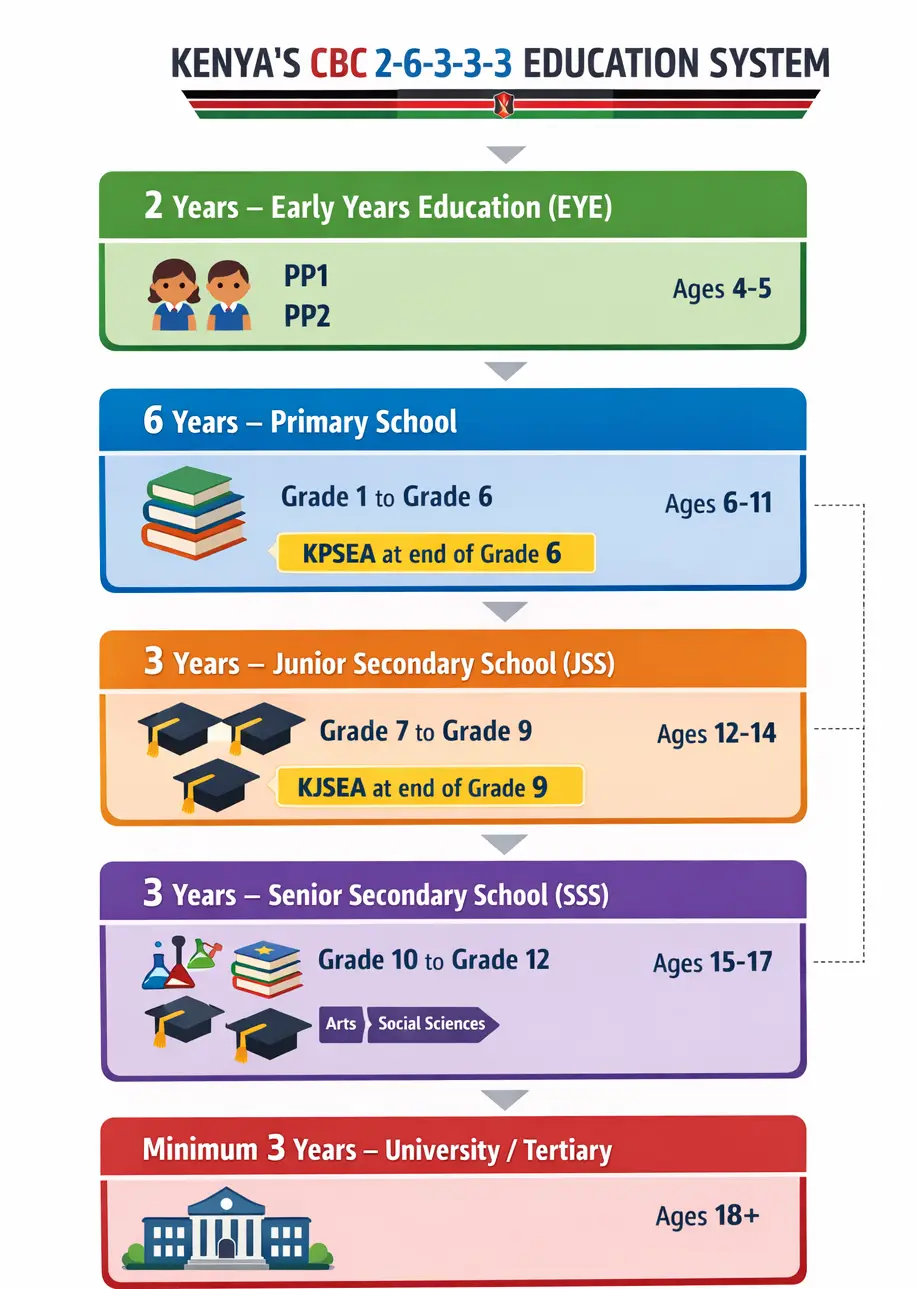
2-6-3-3-3 System - Kenya's CBC structure: 2 years Early Years Education (Pre-Primary), 6 years Primary School, 3 years Junior Secondary, 3 years Senior Secondary, and minimum 3 years University/tertiary education.
Kenya's
CBC Learning Areas and Pathways
KICD - Kenya Institute of Curriculum
Development: The government agency responsible for developing, reviewing, and
implementing Kenya's curriculum, including CBC.
JSS - Junior Secondary School: Grades
7, 8, and 9 in the CBC system, a critical transition phase where learners begin
to explore career pathways. JSS is where learners develop deeper competencies
and prepare for KJSEA, which will determine their Senior Secondary School
pathways.
KJSEA
Pathways - After
completing Grade 9 and sitting KJSEA, learners will choose one of the main
career pathways based on their competencies, interests, and performance.
SSS
Pathways - Senior
Secondary School offers different tracks:
- STEM (Science, Technology,
Engineering, Mathematics)
- Arts and Sports Science
- Social Sciences
- Technical and Vocational
pathways
SNE - Special Needs Education: CBC
provisions for learners with diverse learning needs, ensuring inclusive
education across Kenya.
SSS - Senior Secondary School: Grades
10, 11, and 12 where learners specialize in specific career pathways.
Core
Learning Areas in CBC
CRE - Christian Religious Education:
One of the religious education options in CBC.
IRE - Islamic Religious Education:
Alternative religious education option.
HRE - Hindu Religious Education:
Another religious education pathway available.
HSC - Home Science: Learning area
focusing on practical life skills, nutrition, and home management.
CandD or C&D - Creative and
Design: Encompasses art, craft, music, and design thinking.
PA - Performing Arts: Includes music,
drama, dance, and other performance-based learning.
VA - Visual Arts: Drawing, painting,
sculpture, and other visual creative expressions.
PE - Physical Education: Sports,
health, and physical fitness activities.
Agri - Agriculture: Practical farming
and agricultural science learning area.
L&L - Literacy and Languages:
Foundational competencies in reading, writing, and communication.
Eng - English: Primary language of
instruction and key learning area.
Kisw - Kiswahili: Kenya's national
language and compulsory learning area.
Math or Maths - Mathematics:
Core numeracy and problem-solving competencies.
Int Sci - Integrated Science: Combined
approach to scientific learning before specialization.
SS - Social Studies: Understanding
society, citizenship, and Kenya's place in the world.
Assessment
and Evaluation in Kenya's CBC
KNEC - Kenya National Examinations
Council: The body responsible for national assessments, now adapting to CBC's
competency-based approach.
FA - Formative Assessment: Continuous
assessment during learning, a cornerstone of CBC evaluation in Kenya.
SA - Summative Assessment:
End-of-term or end-of-level evaluations measuring overall competency
achievement.
CA - Continuous Assessment: Regular
ongoing evaluation throughout the term, replacing the heavy emphasis on final
exams.
KPSEA - Kenya Primary School Education
Assessment: The assessment at the end of Grade 6, replacing the former KCPE.
This is the first major national assessment in CBC and determines placement
into Junior Secondary School.
KJSEA - Kenya Junior Secondary Education
Assessment: The assessment at the end of Grade 9 (end of Junior Secondary
School). This assessment will guide learners' pathways into Senior Secondary
School and determines which career tracks they can pursue. The first KJSEA
cohort completed their assessment in November 2025.
KCPE - Kenya Certificate of Primary
Education: The former Standard 8 examination under 8-4-4 (still referenced for
context).
KCSE - Kenya Certificate of Secondary
Education: The examination at the end of the 8-4-4 secondary cycle (being
phased out as CBC progresses).
Performance
Level Rubrics Used in Kenyan Schools
Kenya's
CBC uses a standardized four-level rubric system that teachers must apply
across all learning areas. These appear on every report form:
The
Four Performance Levels
EE - Exceeding Expectations: The
learner demonstrates exceptional mastery of competencies, going beyond what is
required. They can apply skills independently in complex and unfamiliar
situations, showing creativity and innovation. This is the highest level of
achievement in CBC.
ME - Meeting Expectations: The
learner has achieved the expected competency level. They demonstrate solid
understanding and can apply skills consistently in standard contexts. This
represents satisfactory achievement of grade-level expectations.
AE - Approaching Expectations: The
learner is progressing toward competency but hasn't fully met the expected
level yet. They show partial understanding and need some teacher support to
apply skills consistently. This indicates the learner needs additional practice
and intervention.
BE - Below Expectations: The learner
is significantly below the expected competency level and requires substantial
support and intervention. This signals the need for immediate remedial action
and possibly specialized support.
How
Kenyan Teachers Apply These Rubrics
In Kenya's
CBC system, every learning activity, project, and assessment is evaluated using
these four levels. For example:
- A Grade 4 Mathematics teacher
assessing problem-solving might mark a learner as ME if they can
solve multi-step problems using the taught methods
- A Grade 6 Science teacher
might rate a learner as EE if they design and conduct their own
experiment beyond the class requirements
- A Grade 3 Kiswahili teacher
could mark AE if a learner reads simple texts with some fluency but
still needs support with comprehension
Junior
Secondary School (JSS) Rubrics and Assessment
Junior
Secondary School (Grades 7, 8, and 9) uses the same four-level rubric system,
but with increased complexity and depth appropriate for adolescent learners.
Understanding how these rubrics work in JSS is crucial as learners prepare for
KJSEA and future career pathways.
JSS
Performance Expectations:
In Junior
Secondary, the rubrics are applied with more sophisticated expectations:
EE
(Exceeding Expectations) in JSS:
- Demonstrates mastery that goes
significantly beyond grade-level requirements
- Shows initiative in
independent research and project development
- Can synthesize knowledge
across multiple learning areas
- Applies competencies to solve
complex, real-world problems
- Exhibits leadership in group
work and peer learning
- Example: A Grade 8 learner who
not only completes a science experiment but proposes modifications,
predicts outcomes accurately, and explains the broader applications of the
scientific principles involved
ME
(Meeting Expectations) in JSS:
- Consistently demonstrates
grade-level competencies across all strands
- Works independently with
minimal teacher support
- Completes tasks on time with
good quality
- Participates actively in class
discussions and group activities
- Shows solid understanding of
concepts and can apply them appropriately
- Example: A Grade 7 learner who
solves algebraic equations correctly, explains their reasoning, and
applies the concepts to word problems as taught
AE
(Approaching Expectations) in JSS:
- Shows progress but
inconsistent mastery of competencies
- Requires regular teacher
guidance and support
- Demonstrates partial
understanding with gaps in key areas
- May struggle with independent
application of skills
- Shows effort but needs
intervention to reach expected level
- Example: A Grade 9 learner who
understands basic essay structure but struggles to develop coherent
arguments or needs reminders about paragraph transitions
BE
(Below Expectations) in JSS:
- Performance significantly
below grade-level expectations
- Requires intensive support and
intervention
- Shows limited understanding of
fundamental concepts
- Struggles even with guided
practice
- Needs individualized remedial
programme
- Example: A Grade 8 learner who
cannot perform basic calculations necessary for grade-level mathematics
and needs to revisit foundational numeracy skills
JSS-Specific
Assessment Features:
PAT - Performance Assessment Task:
Extended projects in JSS where learners demonstrate competencies over time.
These are heavily weighted in overall assessment and might include research
projects, practical demonstrations, or community-based projects.
Career
Pathways Assessment:
In Grades 7-9, learners are assessed on competencies that will guide their
pathway choices in Senior Secondary School. These include:
- STEM Pathway - Science, Technology,
Engineering, Mathematics readiness
- Arts and Sports Science - Creative and athletic
competencies
- Social Sciences - Humanities, business,
languages readiness
Subject-Specific
JSS Rubrics:
JSS
learners are assessed in specialized learning areas, each with detailed rubric
criteria:
Mathematics:
- EE: Solves complex multi-step
problems, proves mathematical concepts, creates own problems
- ME: Solves grade-level
problems accurately, explains reasoning clearly
- AE: Solves some problems
correctly but makes occasional errors, needs support with complex problems
- BE: Struggles with fundamental
concepts, requires remedial intervention
Languages
(English, Kiswahili):
- EE: Writes sophisticated
compositions with advanced vocabulary, analyzes texts critically, presents
ideas eloquently
- ME: Writes clear,
well-structured texts, comprehends grade-level reading, communicates
effectively
- AE: Basic writing with some
errors, comprehends simple texts, limited expression
- BE: Significant language
difficulties, needs foundational language support
Integrated
Science:
- EE: Designs experiments, makes
predictions, connects science to real-world applications innovatively
- ME: Follows scientific method
correctly, understands concepts, completes practical work successfully
- AE: Basic understanding but
struggles with application, needs guidance in practical work
- BE: Minimal grasp of
scientific concepts, cannot complete practical tasks independently
KJSEA
Preparation and Rubrics:
The Grade
9 assessment (KJSEA) will use these same rubrics but will determine crucial
pathways:
Competency
Areas Assessed in KJSEA:
- Core competencies across all
learning areas
- Subject-specific competencies
in chosen learning areas
- Practical skills demonstration
- Values and attitudes
assessment
KJSEA
Results Interpretation:
- Predominantly EE
ratings: Qualifies for advanced or specialized tracks in all SSS pathways
- Predominantly ME
ratings: Qualifies for regular SSS pathway options based on interests
- Mix of AE and ME:
May need foundation courses in certain areas before full SSS progression
- Predominantly AE or BE:
May require Grade 9 repeat, alternative pathways, or intensive support
programs
Important
Note for JSS Parents:
The rubric ratings your child receives in Grades 7, 8, and 9 are building
toward KJSEA. Consistent tracking and intervention for learners at AE or
BE levels is critical during JSS years to ensure they're ready for both
the assessment and their chosen career pathway.
Additional
Assessment Descriptors
IP - In Progress: The competency is
still being developed; assessment is ongoing.
NYA - Not Yet Assessed: The competency
hasn't been evaluated yet this term.
NA or N/A - Not Applicable:
This competency doesn't apply to this particular learner or context.
Strand-Based
Assessment
Strand - A major component of a learning
area. For example, Kiswahili has strands like Kusoma (Reading), Kuandika
(Writing), Kusikiliza (Listening), and Kuzungumza (Speaking). Each strand is
assessed separately with EE/ME/AE/BE ratings.
Sub-strand - Specific skills within a strand.
Teachers assess learners on multiple sub-strands to build a complete picture of
competency.
Report
Cards and Progress Tracking
PRC - Pupil Report Card: The official
document Kenyan parents receive showing their child's performance across all
learning areas using the rubric system.
LPR - Learner Progress Report:
Alternative term for the report card used in some schools.
E-Assessment - Electronic assessment systems
being piloted in some Kenyan schools for tracking CBC competencies.
Portfolio - Collection of learner's work
samples demonstrating competency development over time, required in CBC
assessment.
Kenyan
Education Structure and Administration
TSC - Teachers Service Commission:
Kenya's body that employs, manages, and develops teachers. TSC has been crucial
in training teachers for CBC implementation.
MOE or MoE - Ministry of
Education: Kenya's government ministry overseeing education policy and CBC
rollout.
NEMIS - National Education Management
Information System: Kenya's database tracking learners, teachers, and schools.
KEMIS - Kenya Education Management
Information System: The government's new comprehensive platform designed to
centralize and streamline all educational data, replacing the current NEMIS
system
UPI - Unique Personal Identifier: The
number assigned to each Kenyan learner for tracking through the education
system.
BOM - Board of Management: The school
governance body in public schools, responsible for supporting CBC
implementation.
PTA - Parent-Teacher Association:
Partnership between parents and teachers, crucial for supporting CBC at home.
QASO - Quality Assurance and Standards
Officer: County and sub-county officials who monitor education standards and
CBC implementation.
CEB - County Education Board:
County-level body overseeing education matters including CBC rollout.
SCDE - Sub-County Director of
Education: Official responsible for education at the sub-county level.
ECDE or ECD - Early Childhood
Development and Education: The foundation level (PP1 and PP2) where CBC begins
in Kenya.
Teacher
Professional Development
INSET - In-Service Education and
Training: Training programs for teachers already in service, heavily used for
CBC orientation.
CPD - Continuous Professional
Development: Ongoing teacher training, including CBC methodology and assessment
techniques.
PLC - Professional Learning Community:
Groups of teachers collaborating to improve CBC implementation.
HOD - Head of Department: Senior
teacher responsible for a specific learning area or department within the
school.
Tutor - Term sometimes used in CBC for
class teachers, especially in lower grades.
TTC - Teacher Training College:
Institutions training new teachers in CBC methodologies.
Learning
Resources and Materials
TLM or T/L Materials - Teaching
and Learning Materials: Resources used in CBC lessons, from charts to digital
content.
CBC
Textbooks -
Approved by KICD, these follow the new curriculum structure and competency
approach.
Learner's
Book - Student
textbook for a specific learning area and grade.
Teacher's
Guide -
Instructional resource helping teachers implement CBC lessons effectively.
SoW - Scheme of Work: Teacher's termly
plan showing how they'll cover the curriculum.
LP - Lesson Plan: Daily plan for each
lesson, showing competencies, activities, and assessment.
Prof
Docs or Professional
Documents - All the planning and assessment records teachers must maintain
for CBC.
Differentiation
and Special Needs
DI - Differentiated Instruction:
Adapting teaching to meet diverse learner needs, a key CBC requirement.
G&T - Gifted and Talented: Learners
exceeding expectations who need enrichment activities.
SEN - Special Educational Needs:
Learners requiring additional support, fully integrated into CBC.
SNE - Special Needs Education: Kenya's
framework for inclusive education within CBC.
"SEN
and SNE are often used interchangeably in Kenyan schools"
IEP - Individualized Education
Programme: Customized plan for learners with special needs.
Remedial - Additional support for learners
performing at AE or BE levels.
Enrichment - Advanced activities for learners
at EE level who need additional challenge.
Learning
Approaches in CBC
PBL - Project-Based Learning: Learners
work on extended projects to develop competencies.
CL - Cooperative Learning: Group work
and collaboration, heavily emphasized in CBC.
SDL - Self-Directed Learning:
Encouraging learners to take initiative in their learning.
Inquiry-Based
Learning -
Learning through questioning, investigation, and discovery.
Learning
by Doing -
Hands-on, practical approach central to CBC philosophy.
Field
Trips or Educational
Tours - Out-of-classroom learning experiences to develop real-world
competencies.
Core
Competencies and Values
Kenya's
CBC is built around seven core competencies and seven values that cut across
all learning areas:
The
Seven Core Competencies
Communication
& Collaboration
- Working with others and expressing ideas effectively.
Critical
Thinking & Problem Solving
- Analyzing issues and finding creative solutions.
Imagination
& Creativity -
Generating new ideas and innovative approaches.
Citizenship - Understanding rights,
responsibilities, and participation in society.
Digital
Literacy - Using
technology effectively and responsibly.
Learning
to Learn -
Self-awareness and ability to direct one's own learning.
Self-Efficacy - Confidence in one's abilities
and belief in one's potential.
The
Seven Core Values
Patriotism - Love for Kenya and pride in
being Kenyan.
Respect - Valuing others and showing
courtesy.
Integrity - Honesty and strong moral
principles.
Unity - Working together across Kenya's
diversity.
Responsibility - Being accountable for actions
and duties.
Social
Justice - Fairness
and equity for all.
Peace - Promoting harmony and resolving
conflicts peacefully.
These
competencies and values are assessed alongside subject-specific skills and
appear on report cards.
Technology
and Digital Learning
DLP - Digital Literacy Programme:
Government initiative providing tablets and digital content to CBC learners.
ICT - Information and Communication
Technology: A core learning area and tool for learning in CBC.
E-Learning - Online and digital learning
resources, increasingly important in CBC delivery.
LMS - Learning Management System:
Digital platforms some schools use for CBC content delivery.
Common
Kenyan School Terms in CBC Context
Term 1,
2, 3 - Kenya's
academic year is divided into three terms, with assessment happening each term.
Opener - First assessment or exam of the
term in many Kenyan schools.
Midterm - Assessment in the middle of the
term.
Endterm or Closer - Final
assessment of the term.
Closing
Day - Last day of
term when report cards are issued.
Academic
Day - Shortened
school day dedicated to academic activities and assessments.
Prize
Giving Day - Event
celebrating learner achievements, adapted for CBC competency recognition.
Understanding
the Shift from 8-4-4 to CBC
For many
Kenyan parents and teachers, understanding CBC means comparing it to what they
knew:
8-4-4 emphasized exam preparation and
theoretical knowledge. Success was measured by KCPE and KCSE scores.
CBC emphasizes practical skills,
values, and competencies. Success is measured by what learners can actually do
(EE, ME, AE, BE) across multiple assessments throughout their learning journey.
"Crammers" - Students who memorized content
for exams in 8-4-4 (CBC aims to eliminate this approach).
"All-round
learner" -
CBC's goal: developing every aspect of the child; academic, physical, social,
emotional, and spiritual.
Understanding
Your Child's CBC Progress: A Parent's Perspective
When
reviewing your child's PRC (Pupil Report Card) with ratings like ME in
Math and AE in Kiswahili, you're seeing a snapshot of their competency
development. Unlike the old system where a mark of 65% might not tell you much,
these rubrics show exactly where your child stands against expected standards.
EE (Exceeding Expectations) doesn't
just mean "A student", it means your child has mastered the
competency and can apply it creatively in new situations.
AE (Approaching Expectations) isn't
failure, it's a signal that your child needs support to reach the expected
level, and the teacher should be providing targeted intervention.
The key is
to understand that CBC is about growth and development, not just grades. When
you attend PTA meetings, discuss your child's portfolio with teachers, and
understand the various strands being assessed, you become a partner in your
child's competency development.
The
Road Ahead
As CBC
continues to mature in Kenya, new acronyms and terminology will emerge. The
first CBC cohort is now in Junior Secondary School (JSS), and as they progress
to Senior Secondary School (SSS) and eventually university, the system will
continue evolving.
Organizations
like KICD, TSC, and KNEC are continuously refining CBC implementation based on
feedback from teachers, parents, and learners. Understanding this vocabulary
helps all stakeholders communicate effectively about learner progress and the
vision for Kenya's education future.
Whether
you're a teacher attending INSET training, a parent reviewing your child's
termly report, or a learner tracking your own competency development, these
acronyms are now part of the Kenyan education conversation. And while the
terminology might seem overwhelming at first, it all serves one purpose:
ensuring every Kenyan child develops the competencies, values, and skills they
need to thrive in the 21st century.
⚠️
Important Note: Educational policies and assessment procedures may
change. For the most current information, always consult:
KICD :KICD Website
Ministry
of Education: MOE Website
The TichaTech
Journal updates: The TichaTech Journal
Your school administration
Comments ()
No comments yet. Be the first to share your thoughts!