January 2026 marked a historic milestone in Kenya's education system as the first cohort of senior secondary school learners began their journey under the Competency-Based Curriculum (CBC). This transition represents more than just a new academic year; it signals a fundamental shift in how we prepare young Kenyans for their future careers.
While the
CBC has sparked considerable debate around implementation costs and structural
changes, one aspect remains particularly puzzling for many parents and
students: the career pathways. This guide breaks down everything you need to
know about navigating these pathways successfully.
What
Are CBC Career Pathways?
Think of
CBC career pathways as personalized roadmaps that guide learners from senior
school into their future professions. Unlike the traditional one-size-fits-all
approach, these pathways are designed around three core elements: your
abilities, your interests, and your career aspirations.
The goal
is simple yet transformative: ensure every student graduates with practical
skills tailored to their strengths, not just theoretical knowledge measured by
exam scores.
When
and How Do Students Choose Their Pathway?
The
pathway selection process is designed to be thoughtful and informed, not
rushed. Here is what you need to know:
Timeline:
- Grade 9 (Junior Secondary): Students begin career
exploration and aptitude assessments. This is when learners start
identifying their interests and strengths through various subjects and
activities.
- End of Grade 9: Students receive guidance and
counseling based on their performance, interests, and career aspirations.
Schools conduct parent-teacher meetings to discuss pathway options.
- Beginning of Grade 10: Final pathway selection is
made. Students officially enroll in their chosen pathway and begin
specialized learning.
The
Selection Process:
The
decision is not made in isolation. It involves a collaborative approach between
the student, parents, teachers, and career counselors. Schools use multiple
indicators including the learner's academic performance in Grade 7-9,
demonstrated interests and talents, results from aptitude assessments, career
interest inventories, and input from subject teachers who have observed the
student's strengths.
Importantly,
this is not a one-time, irreversible decision. The CBC system allows for
pathway adjustments, especially in the early stages of Grade 10, if a student
discovers their initial choice does not align with their abilities or
interests. However, schools encourage students to make informed decisions from
the start to maximize learning continuity.
What
Should Students and Parents Do Now?
If your
child is in Grade 8 or 9, start the conversation early. Discuss their
interests, expose them to different career fields through job shadowing or
career talks, and encourage them to excel in diverse subjects to keep options
open. For those already in Grade 10, embrace the chosen pathway while remaining
open to interdisciplinary learning opportunities that many schools offer.
The Three Main Pathways Explained
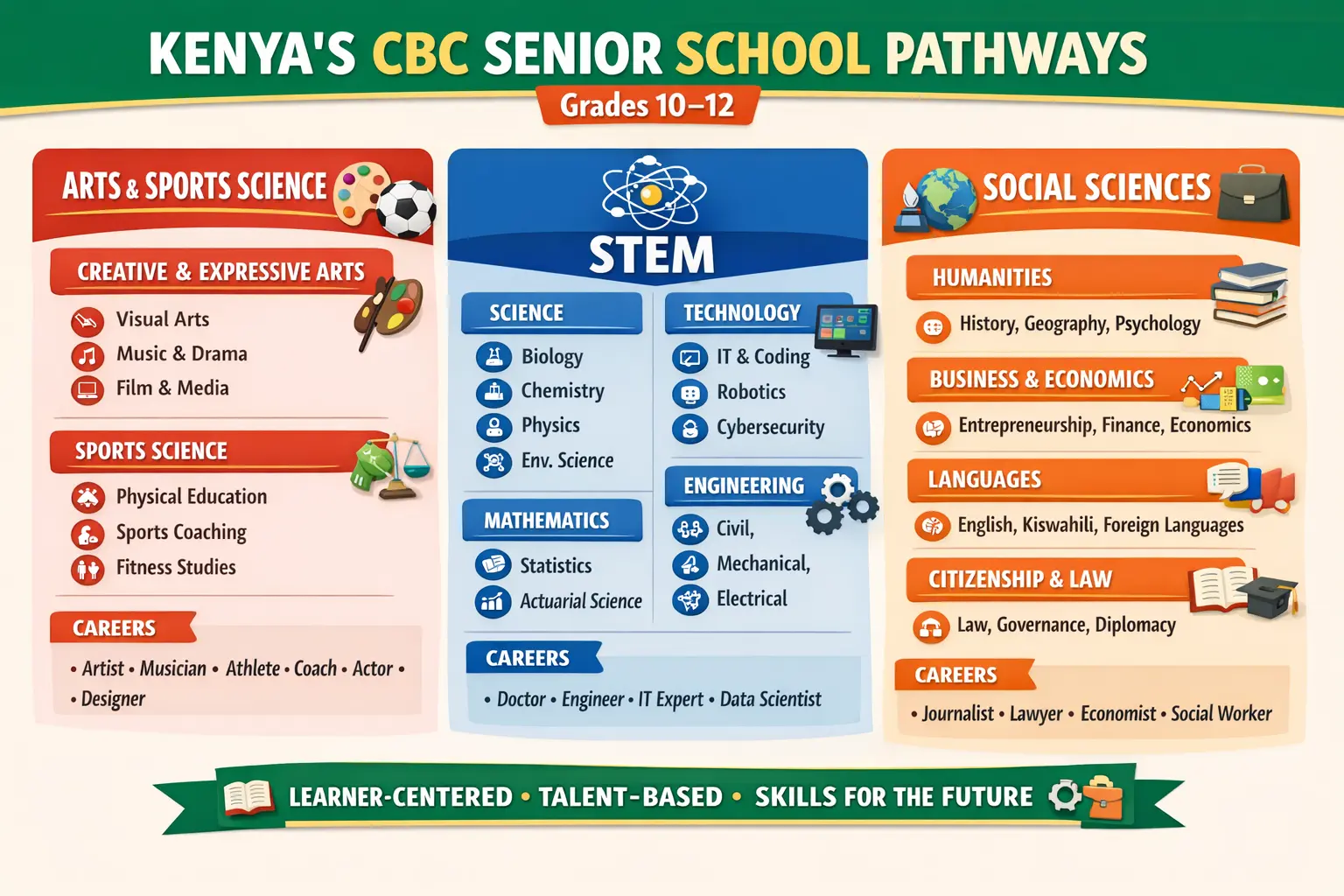
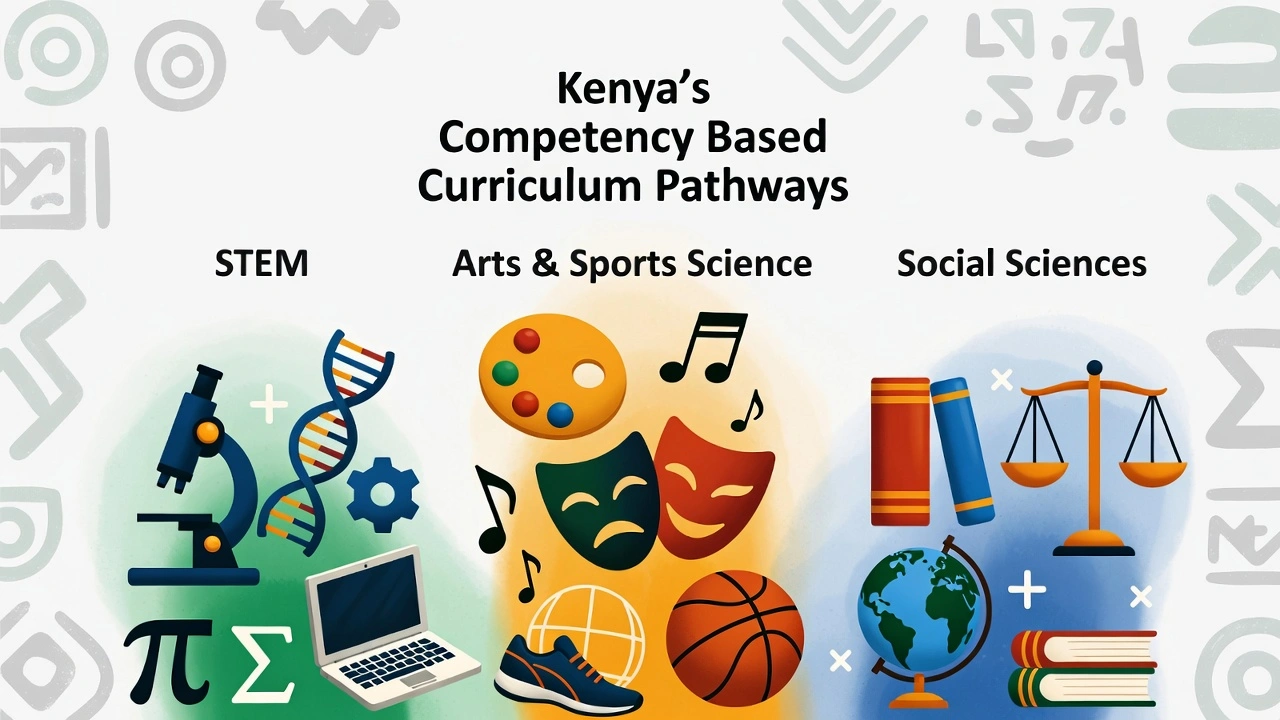
At senior school level (Grades 10-12), students choose from three primary pathways, each containing specialized sub-pathways:
1. Arts
& Sports Science Pathway
This
pathway is perfect for students who thrive on creativity, expression, and
physical excellence.
Creative
& Expressive Arts
For the
artists, performers, and storytellers, this sub-pathway develops skills in
visual arts, performing arts (music, dance, drama), film and media, creative
writing, and fine art design. Graduates can pursue careers as artists,
illustrators, musicians, producers, actors, directors, graphic designers,
content creators, or professionals in Kenya's growing creative economy.
Sports
Science
Athletes
and fitness enthusiasts will find their home here, studying sports science,
physical education, and coaching. Career opportunities include professional
athletics, sports coaching and training, sports science research,
physiotherapy, sports management, and fitness and wellness consulting.
2. STEM
Pathway (Science, Technology, Engineering & Mathematics)
This
pathway cultivates the problem-solvers, innovators, and technical experts Kenya
needs for the future.
Science
Track
Students
dive into biology, chemistry, physics, environmental science, and agricultural
science, opening doors to medicine and health sciences, research and laboratory
work, environmental and climate-focused careers, and agriculture and food
security roles.
Technology
Track
The
digital future starts here with computer science, information technology,
coding and programming, artificial intelligence, data science, and
cybersecurity. Graduates become software developers, IT specialists, data
analysts, AI engineers, and cybersecurity experts.
Engineering
Track
From civil
to automotive engineering, this sub-pathway covers electrical and electronics,
mechanical engineering, mechatronics, telecommunications, and more. Career
options include engineering roles across various sectors, technical positions,
infrastructure specialists, robotics engineers, and industrial technologists.
Mathematics
Track
Number
enthusiasts explore pure mathematics, applied mathematics, statistics, and
actuarial science, leading to careers as actuaries, statisticians, economists,
data scientists, financial analysts, and mathematics educators.
3.
Social Sciences Pathway
This
pathway focuses on understanding society, business, governance, and human
interaction.
Humanities
& Social Sciences
Students
study history, geography, sociology, psychology, religious studies, and
anthropology, preparing for careers in teaching and lecturing, research, policy
analysis, social work, and community development.
Business,
Economics & Entrepreneurship
The
entrepreneurial pathway covers business studies, economics, entrepreneurship,
and financial literacy, grooming future entrepreneurs, business managers,
economists, financial consultants, and project managers.
Languages
& Communication
Master
English, Kiswahili, Kenyan Sign Language, foreign languages (French, German,
Mandarin, Arabic), and indigenous languages to become journalists, translators,
interpreters, diplomats, public relations officers, or media and communications
specialists.
Citizenship,
Governance & Law
This
sub-pathway explores civic education, governance studies, legal studies, and
international relations, creating pathways to careers in law, diplomacy, public
administration, human rights advocacy, and political analysis.
The CBC
Philosophy: Why This Matters
The beauty
of CBC pathways lies in their core principles. They are learner-centered,
recognizing that every student has unique talents, interests, and abilities.
The system offers flexibility and mobility, allowing students to combine
subjects across pathways based on school offerings and personal goals. Most
importantly, CBC values skills, creativity, and practical competence, moving
beyond the exam-only measure of success that has defined Kenyan education for
decades.
Building
Kenya's Future
These
pathways are not just about individual success; they are designed to transform
the nation by reducing unemployment through better skills matching,
strengthening technical and vocational education (TVET), promoting innovation
and entrepreneurship, and preparing learners for both local and global career
opportunities.
Finding
Your Path Forward
Choosing a
pathway as a learner is not a final decision that locks you into one future.
The CBC system encourages exploration and offers the flexibility to combine
interests. A student passionate about both technology and business could blend
subjects from both pathways. Someone interested in sports medicine could merge
sports science with biology.
The key is
to start conversations early with teachers, career counselors, and family
members about where your interests and strengths align. Consider internships,
mentorship opportunities, and exposure to different fields before making your
final pathway selection.
As Kenya's
first CBC senior secondary cohort writes this new chapter in educational
history, the pathways ahead are clearer, more diverse, and more aligned with
the real-world skills the 21st century demands. The question is not just which
pathway you will choose, but how you will use it to shape the future you
envision for yourself and your country.
Have
questions about CBC pathways? Share your thoughts and experiences in the
comments below. Together, we're navigating this new educational landscape.
Comments ()
No comments yet. Be the first to share your thoughts!